I spotted this on Twitter and read it over the year-end/New Year holidays.
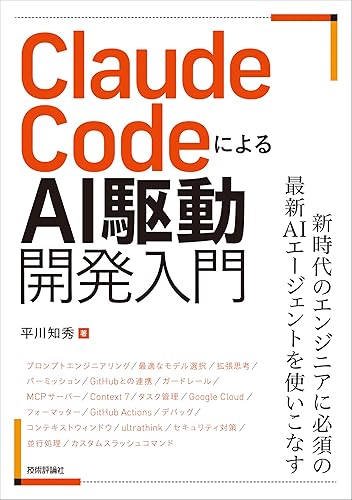
 amazon.co.jp
My vibe coding journey started with Cursor, but since around May of last year, I’ve been almost exclusively using Claude Code. Even writing this blog, I let Claude Code take it from zero to roughly 60% done.
I’ve been keeping up with Claude Code by reading and trying out information that flows through Twitter and blog posts, in a mix of relaxation and a sense of urgency.
Much of the content was already familiar, but it helped me organize my fragmented knowledge and validate many of my assumptions.
The book walks you through building an app step by step, all the way to deploying it on Google Cloud. I found it to be beginner-friendly for those new to vibe coding.
Since I was already a fairly experienced user, I didn’t follow along hands-on, but I think it would make a great tutorial for first-timers.
This is an incredibly fast-moving field, so if you’re interested, I’d recommend buying it and trying it out right away. This is one book you definitely shouldn’t let sit on the shelf lol
Highlights and Notes
Below are my personal notes.
/compact APIの仕様についてフォーカスしてください
(English translation) /compact Focus on API specifications
I may never need it, but I learned that you can pass arguments to /compact.
It seems that slash commands in general allow you to pass arguments both explicitly and loosely.
AnthropicはSOC2 Type2レポート、ISO 27001証明書などを取得しており、詳細はTrust Center 注5.1 で確認できます。
(English translation) Anthropic has obtained SOC2 Type 2 reports, ISO 27001 certifications, and more. Details can be found at the Trust Center Note 5.1 .
I didn’t know that. This could be useful when considering adoption at a company.
touch ~/.config/tmux/tmux.conf
Not directly related to Claude Code, but I discovered that tmux now supports XDG_CONFIG_HOME.
After checking, it appears this has been the case since v3.2a .
claude -p ${プロンプト}を使うとClaude Codeをヘッドレスモードで使うことができます。
(English translation) You can use Claude Code in headless mode with claude -p ${prompt}.
I knew Gemini CLI could do this, but I didn’t realize Claude Code could too. Interesting.
さらに自身のコードを改善するフィードバックループが社内で既に標準化されており、その有用性の高さから将来的に外部開発者向けに公開する可能性も示唆されています。少なくとも本書で紹介した
/security-reviewコマンドは、当初そういった社内ツールの一環だったようです。(English translation) Furthermore, a feedback loop for improving its own code has already been standardized internally, and given its high utility, they’ve hinted at the possibility of making it available to external developers in the future. At the very least, the
/security-reviewcommand introduced in this book appears to have originally been part of such internal tools.
I wonder if these are what they were referring to: